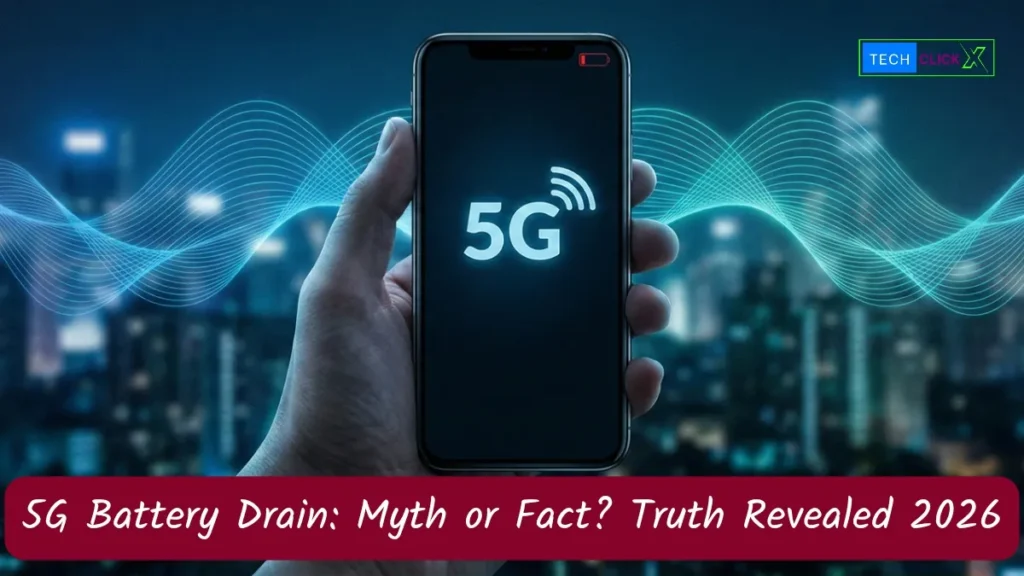
Have you noticed your phone’s battery running out faster ever since you switched to 5G? You’re not alone. Millions of smartphone users worldwide are experiencing the same issue, sparking a heated debate: Is 5G battery drain a myth or a scientifically proven fact? Let’s dive deep into the technology, examine real-world data, and discover practical solutions to optimize your battery life.
Understanding 5G Technology and Power Requirements
5G represents the fifth generation of mobile network technology, promising lightning-fast download speeds, lower latency, and enhanced connectivity. Unlike 4G LTE, which operates on well-established frequency bands, 5G utilizes multiple frequency ranges, including high-band millimeter wave (mmWave) and low-band frequencies. These advanced frequencies require more sophisticated signal processing, which directly impacts how much power your smartphone consumes.
The architecture of current 5G networks also plays a crucial role. Many networks today use Non-Standalone 5G (NSA), meaning your phone maintains simultaneous connections to both 4G and 5G networks. The 4G connection handles voice calls and text messages, while 5G manages data transmission. This dual-network operation significantly increases power consumption compared to using a single network.
The Verdict: Does 5G Really Drain Battery Faster?
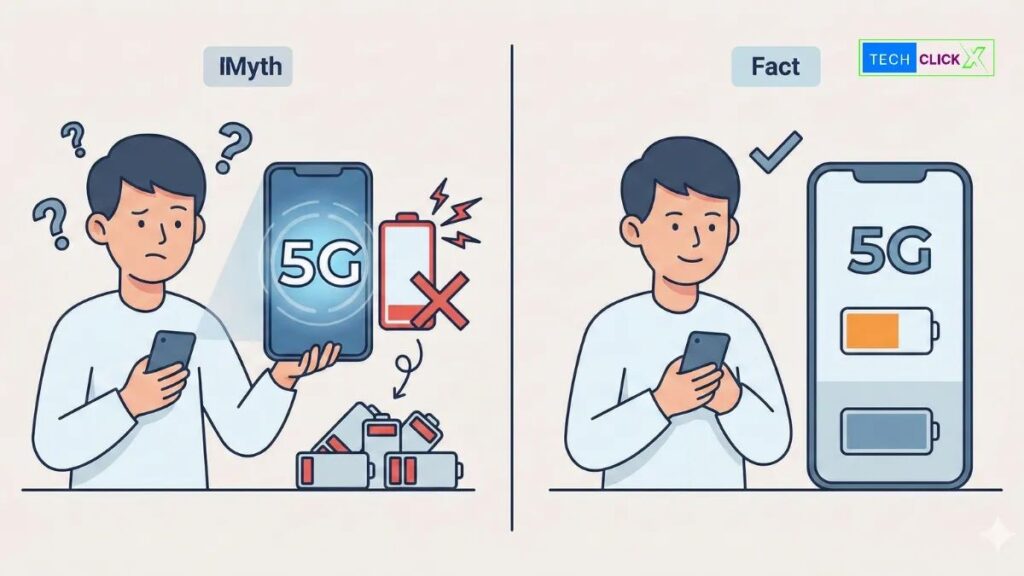
The answer is clear: Yes, 5G does consume more battery than 4G. This isn’t a myth – it’s backed by extensive research and real-world testing. According to a study by Ookla, smartphone users on 5G networks experience between 6% to 11% higher battery drain compared to those using 4G. This percentage may seem small, but it translates to noticeable differences in daily usage.
Real-world iPhone testing reveals even more dramatic results. The iPhone SE 3 lasted one hour longer on 4G than when connected to 5G. The iPad Air and iPhone 13 mini each gained approximately 1.5 hours of additional battery life on 4G, while the iPhone 13 Pro lasted 2.5 hours longer. Android users have reported similar experiences, with some noting 2+ hours of extra screen-on time after switching from 5G to 4G LTE.
Research from the University of California (2021) found that 5G can consume up to 20% more battery power during high-demand activities like video streaming and gaming. A separate 2019 study by Qualcomm indicated that 5G devices can consume up to 50% more battery life when actively in use compared to 4G devices.
Why Does 5G Drain Your Battery Faster?
Several technical factors contribute to increased battery consumption on 5G networks:
- Higher Power Requirements: 5G networks, especially those using millimeter wave frequencies, require significantly more power to maintain strong signal strength and quality. These high-frequency signals have shorter range and are more easily blocked by obstacles, forcing your phone to work harder to maintain connectivity.
- Dual Network Connection (NSA Architecture): Since most 5G networks currently use Non-Standalone architecture, your phone must maintain connections to both 4G and 5G simultaneously. This double duty drains your battery much faster than connecting to a single network. The constant switching and coordination between networks creates additional inefficiencies.
- Constant Tower Searching: When 5G coverage is weak or unstable in your area, your phone continuously searches for the nearest 5G tower. This perpetual scanning process is one of the biggest battery drainers. If your phone setting is locked to “5G On” in areas with poor coverage, you’ll experience dramatic battery drain.
- Increased Data Usage: 5G’s blazing-fast speeds encourage users to engage in more data-intensive activities – streaming 4K videos, downloading large files, and playing online games. These activities naturally consume more battery power, regardless of network type.
Good News: 5G Chipsets Are Getting More Efficient
The technology industry recognizes the battery drain issue and is actively addressing it. In 2025, major chipset manufacturers introduced significant improvements. MediaTek unveiled its M90 5G-Advanced cellular modem with AI-enhanced power efficiency, meeting 3GPP Release 17 and upcoming Release 18 specifications.
Qualcomm’s X85 5G Modem-RF represents a major breakthrough with 30% faster AI inference, delivering substantial improvements in speed, efficiency, coverage, and power consumption. The X85 uses AI-driven traffic prioritization to dynamically manage bandwidth allocation while optimizing battery life. These advanced modems use 4-nm process technology for enhanced power savings, demonstrating that newer devices will handle 5G much more efficiently than earlier models.

Practical Tips to Reduce 5G Battery Drain
You don’t have to sacrifice 5G speeds entirely. Here are proven strategies to extend your battery life:
- Use Smart Data Mode: Apple introduced Smart Data Mode starting with iPhone 12, which automatically switches to LTE when 5G speeds don’t provide noticeably better performance. Android devices offer similar adaptive connectivity features. Enable these intelligent network management tools in your settings.
- Switch to 4G in Weak Coverage Areas: When you’re in locations with poor 5G coverage, manually switch to 4G LTE. Go to Settings > Mobile Networks > Preferred Network Type and select LTE. Your phone will stop wasting power searching for unstable 5G signals.
- Optimize Screen Settings: Your screen is the number one battery consumer. Enable auto-brightness, reduce screen timeout to 30 seconds, and use dark mode on OLED screens where black pixels don’t consume energy.
- Disable Unnecessary Connectivity: Turn off Bluetooth, Wi-Fi scanning, and NFC when not in use. These features constantly scan for connections and drain battery unnecessarily.
- Manage Background Apps: Identify and restrict battery-hungry apps running in the background. Check your battery usage statistics to find the worst offenders.
- Keep Software Updated: System updates often include battery optimization improvements. Always install the latest software versions for your device.
Read also: How to Choose the Best VPN for Streaming in 2026: Ultimate Guide
FAQs
Does turning off 5G really save battery?
Yes, absolutely. Multiple studies and user reports confirm that switching to 4G can extend battery life by 1-2.5 hours depending on your device and usage patterns.
Will future 5G phones have better battery life?
Yes. The latest chipsets from MediaTek and Qualcomm (2025-2026 models) feature AI-powered efficiency improvements and 30% better power management. Newer devices will handle 5G much more efficiently.
Is 5G battery drain worse on budget phones?
Generally yes. Budget phones often use older, less efficient 5G modems that consume more power. Premium devices with latest-generation chipsets handle 5G more efficiently.
Should I buy a 5G phone in 2026?
Yes, but choose wisely. Look for phones with 2025-2026 chipsets (MediaTek M90, Qualcomm X85 or newer) that offer better power efficiency. Also ensure your area has stable 5G coverage to avoid the constant tower-searching battery drain.
The Bottom Line
5G battery drain is definitely a fact, not a myth. Current technology shows measurable increases in power consumption ranging from 6% to 20% depending on usage conditions. However, this doesn’t mean you should avoid 5G entirely. The key is understanding when to use it strategically and implementing smart optimization techniques.
With newer chipsets becoming more efficient and network infrastructure improving, the battery drain issue will gradually diminish. Until then, use Smart Data Mode, switch to 4G when appropriate, and optimize your phone settings. By making informed choices about when and how you use 5G, you can enjoy faster speeds without sacrificing all-day battery life.